
2 min read
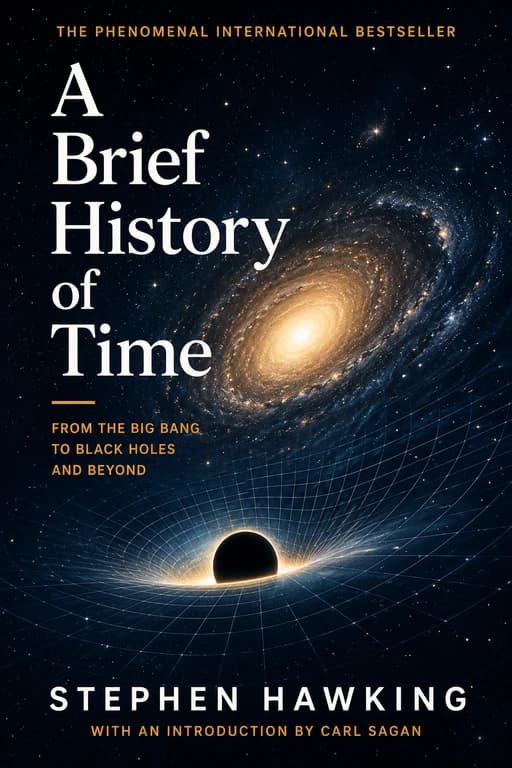
A Brief History of Time
Make room for a question that does not become smaller when you understand a little more.
One-Page Story
The lecture ended with a photograph of a spiral galaxy, and half the audience stood before the lights had fully returned. On the last bus, Imani sat behind a man who had spent the questions section asking why anyone should care about things too far away to affect them. He had not sounded angry. He had sounded tired.
When the bus pulled from the curb, he looked at the programme in her lap. “Did you understand any of it?”
“Some.”
“The part about time bending?”
“Not enough to explain it.”
He laughed once. “That was the only part I wanted explained.” Outside, the shops had shut their grilles. The bus passed a petrol station where someone was washing the pavement with a hose.
“My daughter wanted to come,” he said. “She’s nine. She thinks space is where people go when they’re bored.”
“That’s not a bad definition,” Imani said.
“I told her it was all theories anyway.”
Imani turned the programme over. The back held a diagram she had stared at for an hour without finding a place to begin. “Some of it is,” she said. “Some of it is measurements. And there are parts where people are still trying to make the measurements fit together.”
He considered this as if it were less satisfying than an answer and more useful than none. At the next stop, an older woman carrying two bags asked whether the bus went to Hill Road. The driver said it did not. Imani and the man looked at the route display, then at each other. Neither knew where she should change.
“You’d think they’d put it somewhere,” he said after the woman stepped back to the pavement.
“Maybe they did,” Imani said.
At the next stop, the man stood and buttoned his coat. “I still think the speaker should have explained the bending part,” he said.
“I think she did,” Imani said. “Just not in a way either of us can repeat.”
He considered that, then stepped down onto the pavement. Imani watched him cross toward the closed shops. At the following stop, she got off with the programme still open in her lap.
Why This Book Matters
A Brief History of Time brought questions about space, time, gravity, and cosmology into general reading without pretending that fundamental physics could be made effortless or finally settled.
Its intellectual ambition is part of its reading experience: Hawking invites non-specialists to stay with models, limits, and unanswered questions that change as science develops.
Should You Read It?
Read it if...
- You are drawn to cosmology and willing to read slowly through conceptual difficulty rather than looking for a simplified final answer.
- You want to encounter scientific questions as an intellectual experience, not as proof of a spiritual or motivational claim.
Skip it if...
- You want a current textbook, mathematical training, or a complete account of developments in cosmology since the book was written.
- You prefer science writing that stays close to familiar, immediately practical subjects.
Try This Today
Notice the edge of an explanation
When an explanation interests you today, notice the first point at which you can no longer picture it clearly. Keep that edge in view without forcing it into a personal lesson.