
2 min read
The ONE Thing
by Gary Keller and Jay Papasan
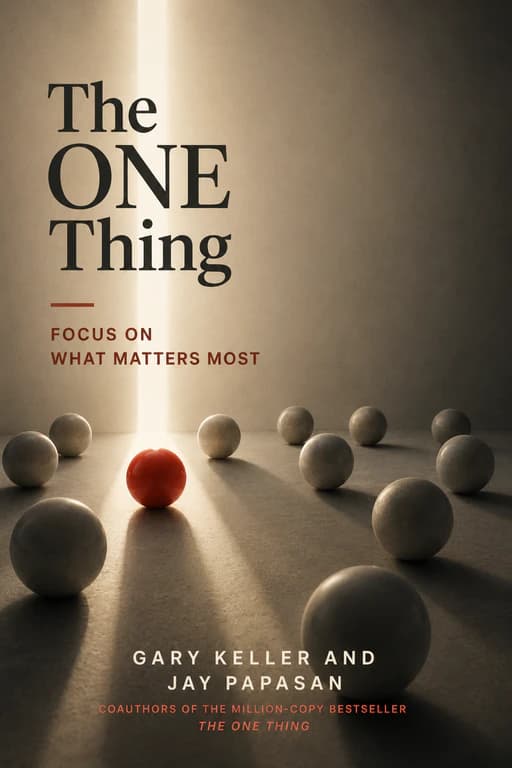
Keller and Papasan offer a deliberately forceful way to challenge a crowded task list when activity has begun to feel more convincing than progress.
One-Page Story
Beena found the snow in the shadow of a retaining wall, where the park path dipped behind the tennis courts. Everywhere else, the morning had turned to wet grass and brown puddles. Here there was one ridge of snow, granular and grey at the edges, packed hard enough to scoop.
She called her brother. “Imran. Come here.”
He was walking ahead with his hands in his pockets, pretending not to hear her. He had refused every snowball fight since they were children, which made the last one of the year more tempting, not less.
“You will ruin your shoes,” he called without turning.
“They are already ruined.”
Beena bent down and scraped at the ridge with both gloves. The snow came away in a lump, cold enough to sting her fingers through the wool. By the time she stood, Imran had crossed the little footbridge and was moving toward the gate.
She ran after him, keeping the snowball tucked against her palm. A dog owner stepped out from behind a hedge with a spaniel pulling hard on its lead. Beena stopped, waited for the lead to pass, then saw Imran glance back over his shoulder.
That was enough. She threw.
The ball hit a man in a black coat between the shoulder blades. It broke apart at once, leaving a dark wet scatter across the fabric.
Imran stopped so suddenly that Beena almost ran into him. The dog began barking at the stranger's ankles. Beena stood with one empty glove raised in front of her.
The man turned. He looked first at the melting snow on his coat, then at Beena, then at Imran, who had already put both hands over his mouth.
“I am so sorry,” Beena said.
The man brushed at his back, missed the wet patch, and gave up. “Was that meant for him?”
Imran made a sound that was almost a laugh and almost a cough.
Beena nodded.
“Poor aim,” the man said, and kept walking toward the gate.
Imran started moving again before she could decide whether to chase him. Beena followed, scooping a handful of slush from the path as she ran. It went straight through her fingers.
Why This Book Matters
Published as a business and self-development book, *The ONE Thing* gives readers one insistent question for narrowing a field of possible actions: which action would simplify the work around it? Gary Keller and Jay Papasan made that prompt unusually portable, which helps explain the book’s long life in productivity culture.
Its usefulness is also its limitation. This is practical counsel with a strong preference for concentration, not a universal account of cognition or work. Some responsibilities cannot safely be deferred, and care, disability, workplace power, uncertainty, and structural conditions can make “one thing” thinking incomplete or inappropriate.
Should You Read It?
Read it if...
- Your days are full, but you still finish them unsure whether the work that mattered actually moved.
- You like simple, memorable frameworks and are willing to test one forceful question rather than adopt an elaborate planning system.
Skip it if...
- Your problem is not deciding what matters: work, care, deadlines, or safety genuinely require attention at the same time.
- You need flexible planning methods, detailed execution help, or strong research evidence rather than a deliberately narrow argument about priority.
Try This Today
Name two good reasons
At one ordinary, low-stakes choice today—where to sit, what to make, which errand to do first—name two honest reasons for the available options.
Choose as you otherwise would. Do not score the choice or search for the best answer; the point is only to notice that a useful question can have more than one legitimate response.