
2 min read
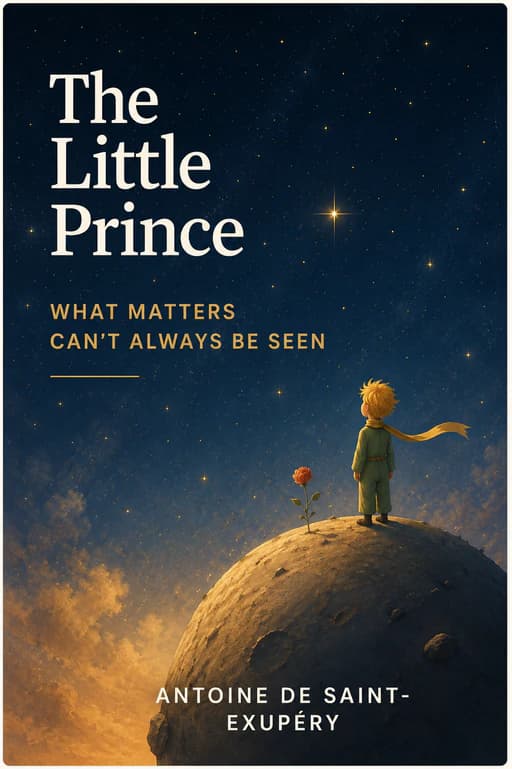
The Little Prince
What if growing up doesn't only teach us what matters—but also teaches us what to overlook?
Continue with the original
One-Page Story
On the last Thursday before the café closed, Rafi began marking the furniture with blue tape.
The tables were going to a hotel supplier, the chairs to whoever bought them at Saturday's sale. He wrote numbers on a clipboard, then under each tabletop: 4, 5, 6. Table Seven had a pale ring near one edge and a burn mark the size of a lentil. Its two chairs never matched. Rafi had meant to replace them for years.
At four ten, a woman in a green raincoat came in and chose the chair facing the window. The café had been quiet since lunch. Rafi was stacking cups when she moved her bag from the other chair to the floor, leaving it empty.
“You're still open?” she asked.
“Until five.”
She nodded as if that settled something and ordered tea.
Rafi remembered her then: Thursdays, usually near closing, sometimes alone, sometimes with another woman who laughed with her hand over her mouth. They never stayed long. Rafi had noticed the extra chair only when he needed it for a crowded table.
At twenty to five, the other woman hurried in, damp-haired and apologizing to no one in particular. Rafi set a second tea on the tray before she reached Table Seven. The woman in the raincoat moved the sugar bowl across without looking up.
“Same week,” the other woman said, easing into the chair.
“Mostly,” said the woman in the raincoat.
For a while they talked about a flat with a broken stove, a train that had been late, a brother who had finally called. Their voices rose and fell beneath the grinder's last cough. Once, both of them stopped speaking to watch rain run down the window.
Rafi turned the sign to CLOSED at five. He did not interrupt. When they stood, the woman in the raincoat pressed her palm over the burn mark before putting on her coat. The other one tucked the blue tape from the table's underside back where it had peeled loose.
On Friday, the supplier's driver lifted Table Seven by one leg and asked whether it went with the rest.
“It does,” Rafi said.
As it passed the front window, the two mismatched chairs knocked softly together.
Why This Book Matters
The Little Prince looks deceptively simple: a short, illustrated, fable-like work with the surface clarity of a children's book. Beneath that simplicity sit questions of attachment, loneliness, responsibility, adulthood, and what people fail to notice when usefulness becomes their dominant way of seeing.
Part of the book's durability comes from refusing to close those questions neatly. A child, teenager, and older reader can encounter the same work and notice different things—not because the story changes, but because the reader does.
Should You Read It?
Read it if...
- You enjoy short, fable-like fiction that uses simple language and symbolic situations to leave larger questions open rather than argue them directly.
- It's especially suited to readers who don't mind a story feeling gentle on the surface while becoming more complicated after they've finished it.
Skip it if...
- You prefer realistic fiction, detailed world-building, or stories that explain their meaning clearly through plot and character development.
- Its childlike surface, allegory, and openness are deliberate. If symbolic storytelling feels vague or overly sentimental to you, this may not be the book that changes your mind.
A Question to Keep
Borrowed attention
What have you learned to see differently only because someone else once cared enough to notice it?
Related Books
2 min read
Meditations
When an outcome will not become fairer through further argument, what remains yours to do?
2 min read
The Alchemist
by Paulo Coelho
A spare, symbolic journey for readers willing to let a novel ask what desire becomes once it is no longer safely unnamed.
Continue with the Original
Ready to continue with the original work? Choose the format that suits you.
OnePageBookStory may earn a commission from qualifying purchases.